
Nearly 100 attendees learn about ‘How Clinical Trials Save Lives’ at free workshop on April 18 at UH Cancer Center
Event at the center in Kaka‘ako also marks 1-year anniversary of Susan C. Hirano Cancer CARE Community patient-empowerment program
April 18, 2026
Nearly 100 people gathered in person and online today, Saturday, April 18, for a free University of Hawaiʻi Cancer Center workshop entitled, “How Clinical Trials Save Lives.” Attendees learned how patients can navigate, and may benefit from, participating in clinical trials of new treatments for cancer; and received an overview of the center’s groundbreaking new Ho‘ōla EPCRC Early Phase Clinical Research Center.
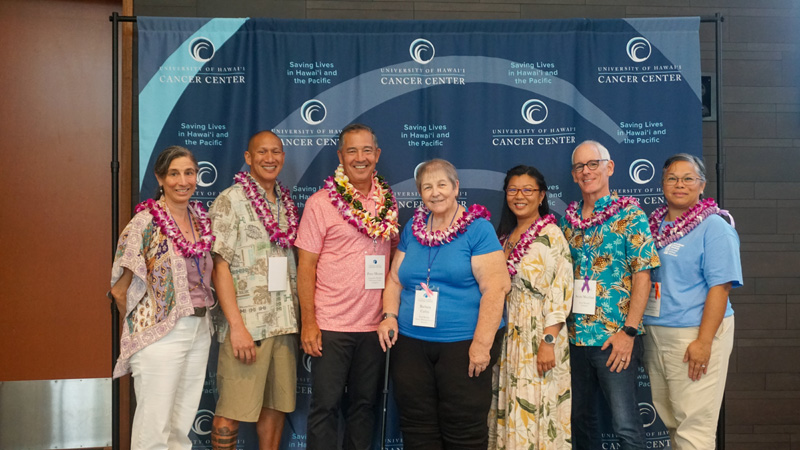
Barbara Carlos, Dana Sehana, Scott Meehan, and Kimberly Omine
The launch of the Ho‘ōla EPCRC, located inside the ‘ewa wing of the UH Cancer Center in Kaka‘ako, means that for the first time in history, Hawaiʻi patients will have the opportunity to access innovative “early phase,” or Phase I, clinical trial treatments for cancer here at home instead of having to fly to the U.S. mainland.
The workshop produced by the center’s Susan C. Hirano Cancer CARE Community program drew together cancer patients, survivors and thrivers; caregivers; friends and family members; and healthcare providers, to hear presentations from experts from the UH Cancer Center, cancer patients who have undergone clinical-trial treatments, and caregivers who have walked the clinical-trial journey with loved ones.
Panelist Kimberly Omine said when her doctors suggested a clinical-trial treatment for her blood cancer in 2024, she took it not only for the chance to heal, but to also advance the science. “I thought, ‘Why not?’ I might be the step to a future cure,” Omine said during the panel discussion. Today, one treatment away from completing her clinical trial treatment, she is considered in remission. “If I didn’t go through clinical trials, I wouldn’t be here,” Omine said.
Attendees received a broad overview of how clinical trials work in “Clinical Trials 101,” a presentation by Dr. Jared Acoba, Associate Researcher at the UH Cancer Center and medical oncologist. Attendees also learned about resources, and key questions to ask, in “Empowerment in Participating in Clinical Trials,” a presentation by Christa Braun-Inglis, also an Associate Researcher at the UH Cancer Center, and an advanced practice provider.
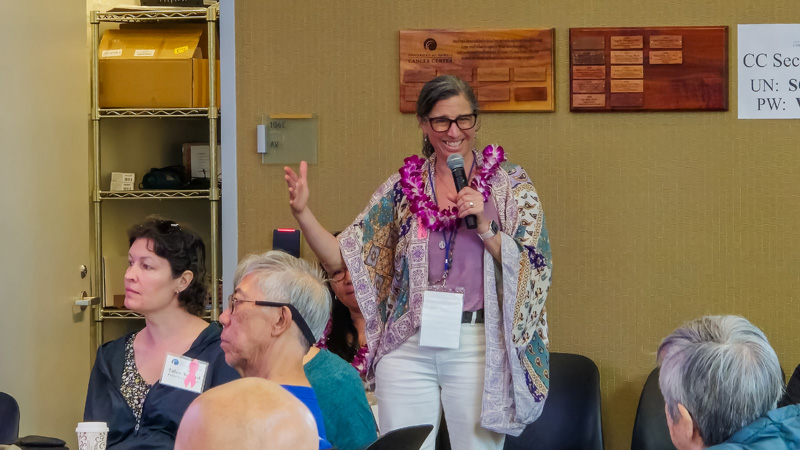
A panel discussion, with questions from the audience, brought forth emotional stories and hard-won advice from cancer survivors Barbara Carlos and Kimberly Omine, and caregivers Dana Senaha and Scott Meehan. A video gave attendees a sneak peek of the Ho‘ōla EPCRC EPCRC clinic space.
“What I would like patients to know is that when they do enroll into a clinical trial, it doesn’t mean that they’re getting any unsafe treatment,” Braun-Inglis said. “They would always be getting at least the standard of care — what they would be getting if the trial wasn't available — and a lot of times it gives them access to future treatments that may actually improve their overall outcomes with cancer.”
Clinical trials pave way to improved treatment for all
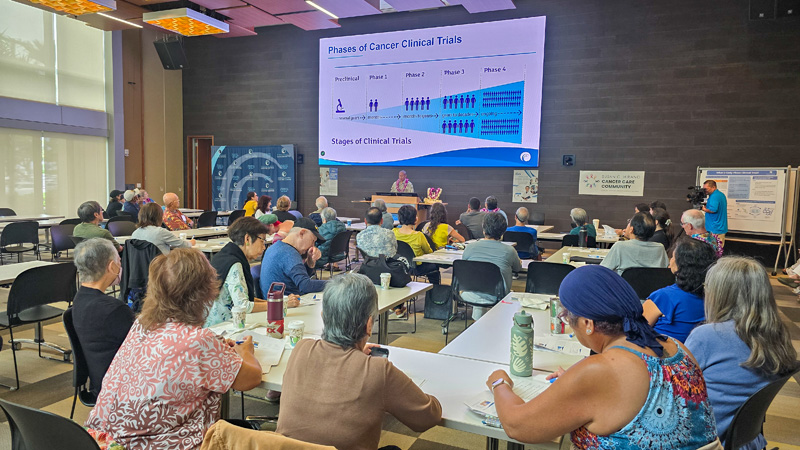
Cancer clinical trials are studies in which people with the disease are given new treatments or new ways of using existing treatments. A trial may involve a certain drug, vaccine, type of surgery, or radiation, or a combination of treatments. Every clinical trial is different, so risks also differ. But the benefits of undergoing a clinical trial include early access to life-saving new treatments that may not be available to people outside the trial. The research team closely monitors the clinical-trial patient, adding an extra layer of care. The trial may help researchers learn more about cancer and help people in the future.
The University of Hawaiʻi Cancer Center administers nearly 90% of all cancer clinical trials in Hawaiʻi, in partnership with member organizations of the Hawaiʻi Cancer Consortium.
“Clinical trials are where research can turn into real hope for patients,” said Dr. Naoto T. Ueno, Director of the University of Hawaiʻi Cancer Center, who is also a cancer researcher, clinical oncologist, clinical trial scientist, and a two-time cancer survivor himself. “Clinical trials give patients access to promising new therapies that are not yet widely available — sometimes offering options when standard treatments are no longer effective. These trials can extend lives, improve quality of life, and, in some cases, lead to breakthroughs that change the standard of care for future patients. Through this Susan C. Hirano Cancer CARE Community event, we are helping people understand that participating in clinical trials is not only about advancing science — it is about giving patients and families new possibilities and new hope, right here in Hawaiʻi.”
First anniversary of Susan C. Hirano Cancer CARE Community celebrated
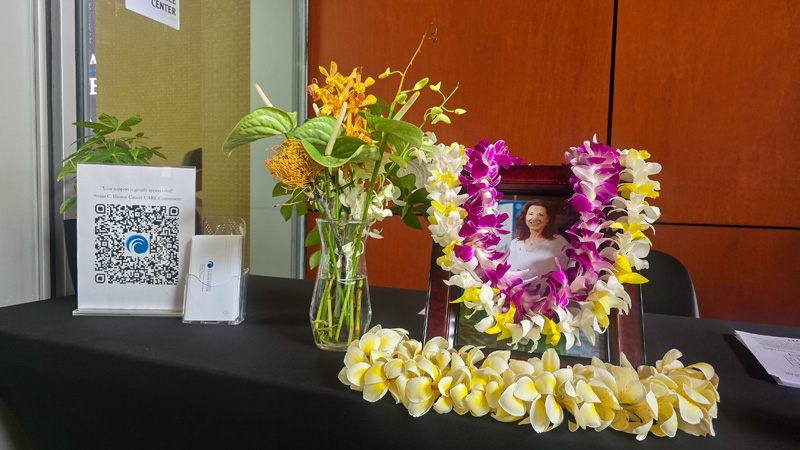
anniversary of the Susan C. Hirano Cancer Care Community
Program and her lasting legacy
Saturday’s event also marked the one-year anniversary of the center’s Susan C. Hirano Cancer CARE Community patient-empowerment program at the UH Cancer Center. The program’s late founder, Hope Ambassador Susan Hirano, passed away exactly one year prior, on April 18, 2025. She had launched the Cancer CARE Community program only two weeks prior.
Over the past year the Susan C. Hirano Cancer CARE Community has brought together hundreds of patients, caregivers, survivors, physicians, and researchers to share knowledge, build connections, and share support. Its quarterly events have drawn hundreds of people, and the program is only growing.
For Peter Hirano, Susan’s husband, the anniversary of the program, and the launch of Ho‘ōla EPCRC EPCRC, are full of meaning.
“The whole vision of the Cancer CARE Community was to create a community for people who are going through the same journeys — whether they be a patient, survivor, thriver, caregiver, family member — and for them to find connection and to be empowered to advocate for themselves. And this program has done a wonderful job over the course of the last year,” Peter Hirano said.
“To me, Ho‘ōla EPCRC (EPCRC) means hope,” Peter Hirano added. “The hope is that for patients like Sue in the future are going to have a place to come locally, where they don't have to travel, and be away from their support network, in order to get these groundbreaking treatments.”
Learn more about the Susan C. Hirano Cancer CARE Community. The program’s next events are “Healing Through Art” on July 18, and a program on physical activity on October 17.
Learn more about the UH Cancer Center.


