
Our lab studies molecular genetics and signaling pathways during liver cancer growth to develop new therapies to treat liver cancer. We are studying multiple types of liver cancer, including hepatocellular carcinoma (HCC), intrahepatic cholangiocarcinoma (ICC), and hepatoblastoma (HB).

Figure 1: mTORC1/2 inhibitor INK128 effectively inhibits ICC cell growth. (A) Treatment of human ICC cell line KKU156 with INK128 in vitro; (B) Treatment of mouse ICC with INK128 significantly decreased tumor burden in mice
Both Hippo and Notch signaling cascades are evolutionally conserved pathways and have played critical roles in development, regeneration, and carcinogenesis. Both pathways have been implicated in liver tumor development. We found that Notch is a key downstream effector of Hippo tumor suppressor pathway, and the two pathways regulate liver tumor cell differentiation status.
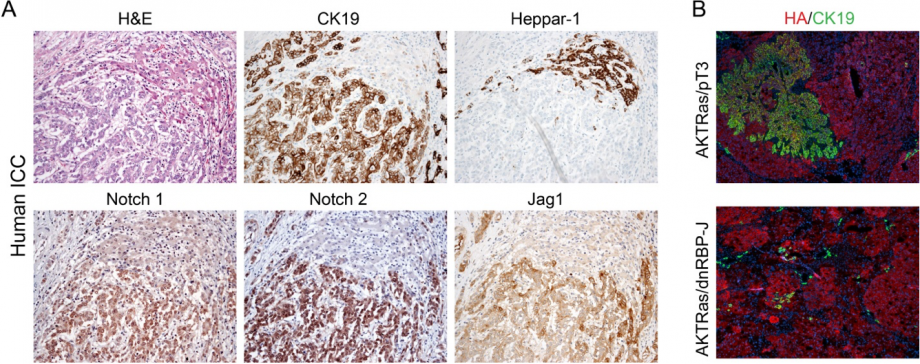
Figure 2: Notch signaling is required for ICC development. (A) Expression of Notch pathway genes in human ICC samples by immunohistochemical staining; (B) blocking Notch signaling by co-expression dominant negative form of RBP-J (dnRBP-J) prevented ICC-like lesion development in AKT/Ras drive mouse liver tumor model.
Aberrant metabolism is a hallmark of cancer. Our lab studies how glucose and fatty acid catabolism pathways are deregulated during liver tumor development and how these metabolic pathways contribute to hepatocarcinogenesis.
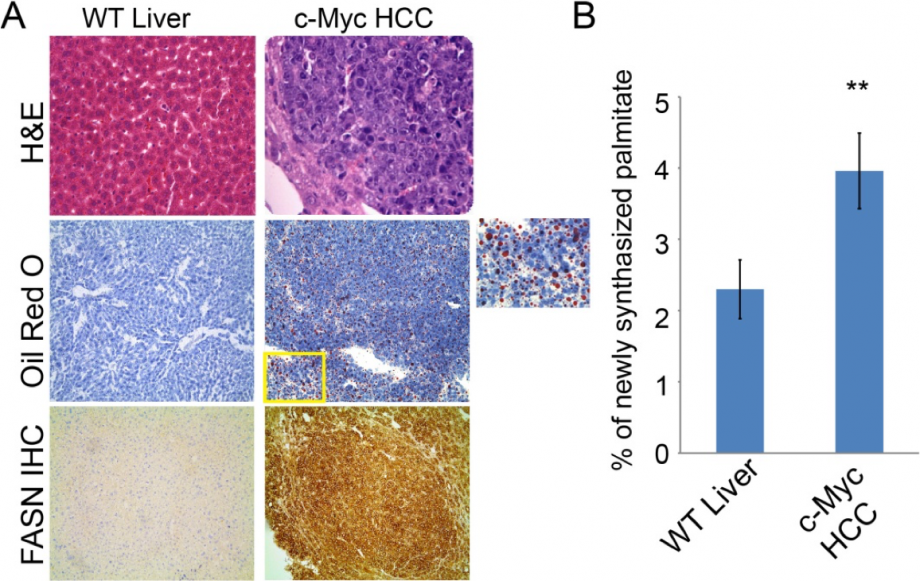
Figure 3: Increased lipogenesis in c-Myc induced mouse HCC. (A) H&E, Oil Red O (lipid droplet), and immunohistochemical (IHC) staining of FASN in wildtype (WT) normal liver and c-Myc HCC tissues. Inset: the expanded view of the yellow box. (B) Rate of de novo lipogenesis measured by 2H2O labeling in wildtype (WT) liver and c-Myc HCC tissues.